A base 18-foot pontoon starts in the low $20,000s, and a loaded tritoon can push past $150,000. Nearly all of that spread comes down to tube count, engine size, and trim level.
The lake you boat on settles those three choices before you ever walk a showroom. Work through them in order and the seventeen models on the lot narrow to two or three fast.
Start With the Lake You Boat On
Be honest about the water you actually spend weekends on. A 17-foot base pontoon on a quiet residential lake and a 23-foot performance tritoon on the big lake are different purchases, and mixing them up is the mistake we see most.
On Lake Winnipesaukee, the southwest wind builds real chop across the open main basin most summer afternoons. A base two-tube pontoon at 60 horsepower gets uncomfortable out there. Winnipesaukee calls for a performance tube package, at least 90 to 115 horsepower, and the handling to match.
Lake Winnisquam and Ossipee Lake are calmer and more protected. A 20-foot two-tube at base engine ratings handles both without anyone feeling like they bought the wrong boat.
How Tube Configuration Changes the Ride
Tube count changes how the boat planes, turns, and takes chop, and it’s where most of the price spread lives. A standard pontoon rides on two aluminum tubes, and a tritoon adds a third down the center. Bennington builds this out in steps you can feel on the water, not just read on a spec sheet.
Standard Two-Tube Pontoon
The baseline. Most two-tube models carry engine ratings around 90 horsepower, handle calm water well, sit stable at rest, and trailer easily. It’s the right call for protected lakes and for buyers who mostly cruise and fish rather than tow or run open water.
SPS Performance Tritoon
Bennington’s Sport Performance System adds a 25-inch center tube, with performance foils and splash fins cutting spray off the outer tubes. The hull planes on three contact points instead of rocking between two, which tightens turning and reduces the outward lean in corners. Engine ratings climb into the 115 to 150 horsepower range on most S Line models.
On any lake with afternoon wind, the difference shows up well before top speed. Bennington pontoons in the S Line range are the most common SPS boats buyers cross-shop in this region, and they hold their condition and value well next to entry-level alternatives.
ESP High-Performance Tritoon
The Elliptical Sport Package swaps the center tube for Bennington’s patented 32-inch elliptical tube, wider than the 25-inch outers and set deeper in the water. That geometry gives the hull a deadrise-like angle, so the boat banks into turns the way a V-hull does. It also opens engine ratings past 300 horsepower, with twin setups on the biggest models.
The ride in chop is a different category from anything in the SPS range. This is a boat that performs outright rather than performs for a pontoon, and the price reflects that.
Find the Right Size for Your Crew
For a family of four to six, a 20 to 22-foot pontoon is the sweet spot. Long enough to feel roomy, short enough to trailer at most public ramps without stress. Groups that regularly bring 8 to 10 people should move up to 22 or 23 feet, where the extra deck space stops being marginal.
One thing the brochure capacity number hides. Manufacturers rate by total weight, which includes gear, the cooler, the anchor, and everything else that comes aboard. A boat rated for 12 passengers gets crowded well before the legal limit on a full lake day.
Choose a Layout for the Way You Boat
Layout affects daily use more than any line on the spec sheet, and it gets the least attention in most buying conversations.
Open Bow for More Seating
Seating built into the forward section ahead of the bimini, facing inward. It adds room for two to four more people and creates a wraparound setup that works well at anchor. The tradeoff is spray at speed and in chop.
Quad Bench for Larger Groups
The Q in a Bennington model name means four individual chaise lounges split between bow and stern in place of the standard L-bench. You get under-seat storage in all four corners and defined seating zones. For boats that regularly carry 8 or more, it keeps the deck from feeling like one undifferentiated couch.
Swingback for Swimming and Towing
The SSB rear lounge pivots to face the stern. Forward, it works as normal seating. Rotated back, it clears the transom and lets passengers watch whoever is in the water or behind the boat, which is why families who swim and tow all day pay the upcharge for it.
Know What to Check Before You Buy
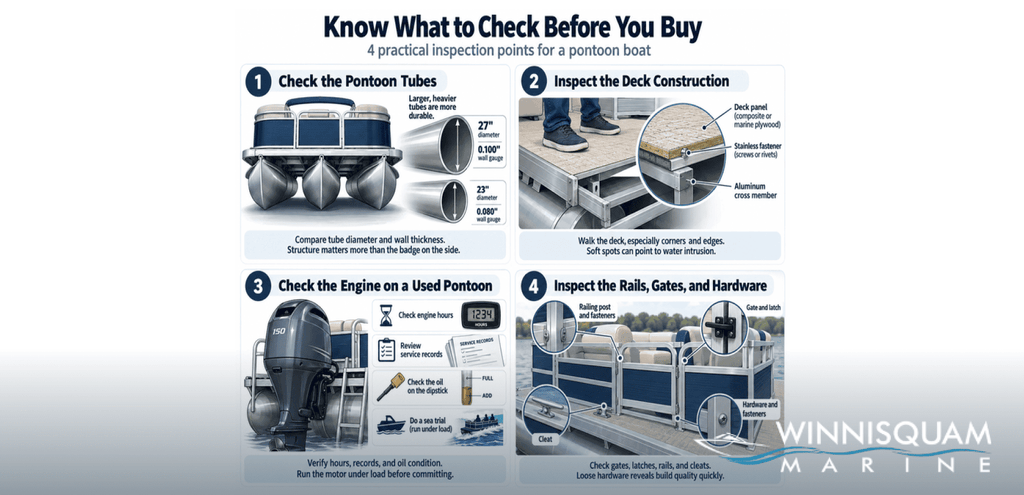
Buyers spend too much time comparing spec sheets and not enough on the physical checks that decide how the boat holds up over five to ten years.
1. Check the Pontoon Tubes
The structure lives in the aluminum. A 25-inch tube with a heavier wall gauge is a more durable platform than a 22-inch tube at thin spec, whatever the nameplate says. Ask for both numbers on any boat you’re serious about.
2. Inspect the Deck Construction
Walk the deck, specifically the corners and edges where panels meet the aluminum frame. Soft spots mean water intrusion. Check how the panels fasten to the cross members, because the fastening tells you whether the boat was built for years of thermal expansion or assembled to look good on a showroom floor.
3. Check the Engine on a Used Pontoon
Verify hours, ask for service records, and pull the dipstick. Milky oil means water, and water in an outboard’s oil means a failed seal, not routine maintenance. Run the engine under load before committing.
Any dealer worth buying from has already run a used boat through a service inspection before it hit the lot. If they can’t confirm that, ask why.
4. Inspect the Rails, Gates, and Hardware
Walk the full perimeter and work every gate latch, railing post, and cleat. These parts take the most daily use and expose build differences first. Loose gate hardware on a showroom floor tells you what the rest of the build is like.
Match the Engine to the Pontoon
The engine has to match the hull rating, or you’re paying for something you can’t use. A two-tube hull rated for 90 horsepower gains nothing from 115, and a three-tube SPS build rated for 150 is underperforming with a 60 on the transom.
On NH lakes, a 90 horsepower Mercury on a 20-foot two-tube covers cruising, light towing, and fishing. If Winnipesaukee is home and afternoon runs and towing are in the picture, 115 to 150 on a performance-tubed hull is where the boat handles what the lake demands. The ESP twin-engine route only makes sense once the hull rating supports it.
Look Beyond the Purchase Price
The sticker is the starting point. Add a trailer, registration, insurance, dock fees or storage, and a first season of fuel and maintenance to see what year one actually costs. Comparing financing terms before assuming a cash purchase usually changes the math too.
Run one more number before locking a budget. Bennington tends to hold resale value better than entry-level brands at comparable age and condition, so part of the price gap comes back at sale time. If you plan to trade up within five to seven years, a trade-in evaluation on your current boat closes the gap further than the stickers suggest.
New vs Used Pontoon Boats
The case for used is simple. A well-kept 23-foot Bennington with the SPS package often costs what a base 20-foot new model does.
New gets you the factory warranty, your exact configuration, and no unknown history. Browsing used pontoons gets you more boat per dollar, as long as the boat went through a service inspection before it was listed. A dealer-inspected pontoon is a different purchase from a private sale with no engine documentation.
We go back and forth on this one with buyers every week, and there’s no clean answer. If a factory warranty lets you sleep at night, buy new. If three more feet of boat for the same money matters more, the used lot wins, and it wins slightly more often than not.
Get on the Water Before You Decide
Nothing settles the SPS question like a day on the water. Boat rentals on Lake Winnisquam put you on different pontoon types before you commit, and a morning on a base two-tube followed by an afternoon on an SPS boat tells you which one fits your actual weekends.
We’ve been selling boats on these three lakes since 1977. Walk into any of our locations with your lake, your headcount, and what you do on the water, and the field narrows to two or three real options fast.
FAQs
How much does a new pontoon boat cost?
Entry-level 17 and 18-footers start in the low $20,000s, and a loaded ESP tritoon can pass $150,000. Most Lakes Region buyers land between $45,000 and $80,000 for a 20 to 23-foot Bennington with a performance package. Tube count, engine size, and trim level decide where in that range a specific boat falls.
What size pontoon do I need?
A 20 to 22-foot pontoon covers a family of four to six on any NH lake. Groups of 8 or more are happier at 22 to 23 feet with a quad bench or similar layout. On Winnipesaukee, start at 21 feet with a performance-tubed hull rather than a base two-tube at low horsepower.
Do I need the SPS package?
On a calm, protected lake where you mostly cruise and fish, a base two-tube handles the conditions without compromise. On Winnipesaukee or anywhere with real afternoon wind, you’ll notice what SPS does by your second summer. If you plan to tow wakeboarders or skiers regularly, get it no matter which lake you’re on.
How do I choose between a pontoon and a tritoon?
Handling, fuel use, towing capacity, and price all shift between the two configurations. The tritoon vs pontoon guide breaks down each variable in enough depth to settle most decisions before a test ride.